Deadline Date: Wednesday 17 December 2025
Requirement: Systems Monitoring via ZABBIX
Location: Brussels, Belgium
Full Time On-Site: Yes
Time On-Site: 100%
Period of Performance: 2026 BASE: As soon as possible but not later than 01 February 2026 – 31 December 2026 with the possibility to exercise the following options:
2027 Option: 1 January 2027 until 31 December 2027
2028 Option: 1 January 2028 until 31 December 2028
Required Security Clearance: NATO SECRET
1 INTRODUCTION
NCIA – CSU BRU
Within the Agency, CIS Support Unit (CSU) Brussels provides consistent, reliable and cost-effective ICT service delivery to all NATO customers located in the NATO compound in Brussels, including understanding and managing the interface with the Secretary General and Deputy Director General International Military Staff (DG IMS), through his/her delegated representatives ICTM/EXCO IMS, who act in the role of Intelligent Customer.
Coherence Branch
The Coherence (COH) Branch supports the Agency’s Demand Management (DM) organization, and is responsible for liaison with all customers in the CSU’s Area of Responsibility and supports the Commander CSU in the role as NCIA representative and provides a single entry point for customers. The Coherence Branch contributes and/or conducts monitoring and measurement of customer satisfaction. COH supports the management of all agreements concerning Service Provision, Operations and Exercises within the CSU AoR. The Coherence Branch supports Service Lines in the implementation and improvement of service management processes.
Coherence Branch – Service Management and Control (SMC) Team
Within the Coherence Branch, the Service Management and Control (SMC) Team is responsible for the ITSM and System Monitoring Toolsets.
The team is looking for support regarding maintenance, operating and implementing a new monitoring system based on Zabbix. It is the intention to cover eight networks over various classifications containing hundreds of servers, communication devices, and applications. Services to be provided are related to visualising the captured data, forwarding infrastructure events to trigger automated ticket generation to prevent outages, recording capacity statistics for timely expansion of the infrastructure.
For this support, it is envisioned that support needs to be provided by ONE resource, having the skills of a Zabbix System Monitoring Engineer. This support will be provided under the direction of the Head of the Branch and the SMC Toolsets Manager.
2 OBJECTIVES
The main objectives of this statement of work can be summarized as follows:
3 SCOPE OF WORK
The following deliverables are expected from this statement of work:
The following activities shall be supported:
a) Configuration updates and code development:
b) Continuous Improvement:
c) Collaboration with IT Teams:
The services shall be carried out in sprints whereby each sprint is independent. The content and scope of each sprint will be agreed with the SMC manager and technical staff during the sprint-planning meeting, in relation with the above activities, in writing.
The measurement of execution for this service is sprints, with each sprint planned for a duration of 1 calendar week.
Due to the AGILE approach of this project, there is a need to define a set of specific arrangements between NCIA and the contractor that specifically defines the deliverables to be provided for each sprint as well as their associated acceptance criteria. This includes sprint planning, execution and review processes, which are detailed below:
1. Sprint Planning:
Objective: Plan the objectives for the upcoming sprint.
Kick-off meeting: Conduct a monthly meeting with the contractor to plan the objectives of upcoming sprints and review contractor`s manpower to meet the agreed deliverables.
Set sprint goals: Define clear, achievable goals for the sprint and associated acceptance criteria, including specific delivery targets, Quality standards as well as Key Performance Indicators (KPIs) for each task to be recorded in the sprint meeting minutes.
Agree on the required level of effort for the various sprint tasks.
Backlog Review: Review and prioritise the backlog of tasks, issues, and improvements from previous sprints.
Assess each payment milestone cycle duration of 1 calendar month. State of completion and validation of each sprint status and sign off sprints to be submitted for payment as covered in Section 4.
2. Sprint Execution
Objective: Contractor to execute the agreed “sprint plans” with continuous monitoring and adjustments.
Regular meetings between NCI Agency and the contractor to review sprint progress, address issues and make necessary adjustments to the processes or production methodology. The Meetings will be physically in the office, or in person via electronic means using Conference Call capabilities, according to the NCIA project manager’s instructions.
Continuous improvement: Contractor to establish a continuous feedback loop to gather input from all stakeholders for ongoing improvements and their subsequent implementation depending on NCIA approval.
Progress Tracking: Contractor to use a shared dashboard or tool to track the status of the sprint deliveries and any issues.
Quality Assurance/Quality Check: Contractor shall ensure that the quality standards agreed for the sprint deliverables are maintained throughout the sprint.
Quality Control: NCIA to perform the Final Quality Control of the agreed deliverables and provide feedback on any issues.
3. Sprint Review
Objective: Review the sprint performance and identify areas for improvement.
At the end of each sprint, there will be a meeting between NCIA and the Contractor to review the outcomes against the acceptance criteria comprising sprint goals, agreed quality criteria and Key Performance Indicators (KPIs).
Define specific actions to address issues and enhance the next sprint.
4. Sprint Payment
For each sprint to be considered as complete and payable, the contractor must report the outcome of their work during the sprint, first verbally during the retrospective sprint review meeting and then in writing within three days after the sprint’s end date. A report must be sent by email to the NCIA project manager, listing all the work achieved against the agreed tasking list set for the sprint.
The contractor's payment for each sprint will be depending upon the achievement of agreed Acceptance Criteria for each task, defined at the sprint planning stage. This will include specific delivery targets, quality standards as well as Key Performance Indicators (KPIs) for each task.
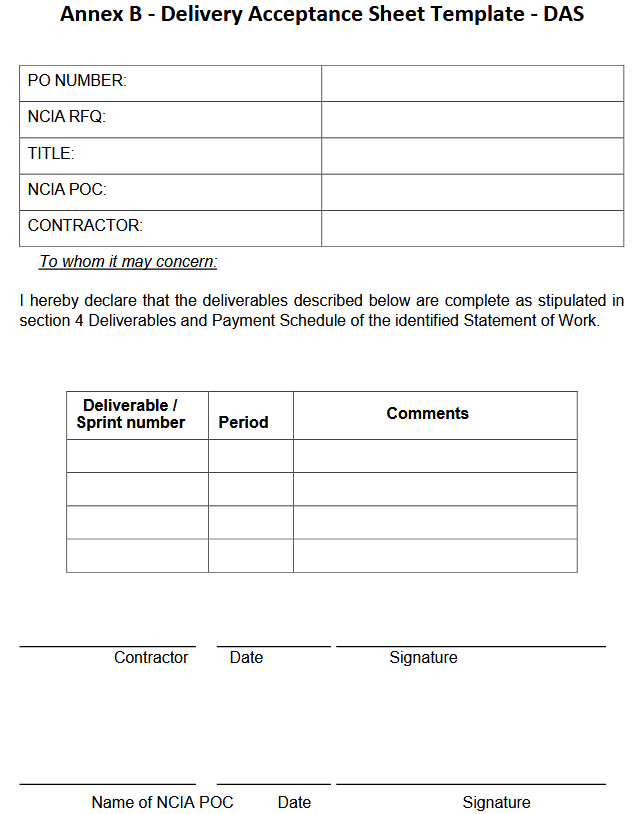
The payment shall be dependent upon successful acceptance as set in the above planning/review meetings. This will follow the payment milestones that shall include a completed Delivery Acceptance Sheet (DAS).
Invoices shall be accompanied with a Delivery Acceptance Sheet (DAS) – signed by the Contractor and project authority.
If the contractor fails to meet the agreed Acceptance criteria for any task, NCIA reserves the right to withhold payment for that task/sprint.
4 DELIVERABLES AND PAYMENT MILESTONES
The following deliverables are expected from this statement of work:
1. Complete the activities/tasks agreed in each sprint meeting as per sections 2 and 3 above;
2. Produce sprint completion reports (format: e-mail update), which include details of activities performed and the list of the deliverables of the week;
3. The Contractor will participate in the daily reporting and planning activities (daily stand-ups) as well as the required participation in workshops, events and conferences related to the supported services, as requested by the SMC Manager.
Payment Schedule will be according to payment milestones upon completion of 4 consecutive sprints, following the acceptance of each the sprint report.
NCIA reserves the right to exercise a number of options of one or more sprints based on the same scrum deliverables, at a later time, depending on the project priorities and requirements, at the following cost: for base year (2026) at the same cost, for outer years (2027-2028) the Price Adjustment Formula will be applied in accordance with paragraph 6.5 of the Framework Contract Special Provisions.
The payment shall be dependent upon successful acceptance of the sprint report and the Delivery Acceptance Sheet (DAS) – (Annex A)
Invoices shall be accompanied with a Delivery Acceptance Sheet (Annex A) signed by the Contractor and the NCIA POC.
The following deliverables are expected from the service on this statement of work:
2026 BASE: As soon as possible but not later 1 February 2026 to 31 December 2026:
Deliverable: 44 sprints of Provision of support to Security Posture with network monitoring (Number of sprints is estimated and will be adjusted based on actual starting date.)
Payment Milestones: Upon completion of each fourth sprint. Completion of this milestone shall be accompanied by the Delivery Acceptance Sheet (DAS) – (Annex B), signed for acceptance by the Purchaser’s authorized point of contact and the Contractor
2027 OPTION: 01 January 2027 to 31 December 2027:
Deliverable: 44 sprints of Provision of support to Security Posture with network monitoring
Cost Ceiling: Price will be determined by applying the price adjustment formula as outlined in CO‐115786‐ AAS+ Special Provisions article 6.5.
Payment Milestones: Upon completion of each fourth sprint. Completion of this milestone shall be accompanied by the Delivery Acceptance Sheet (DAS) – (Annex B), signed for acceptance by the Purchaser’s authorized point of contact and the Contractor
2028 OPTION: 01 January 2028 to 31 December 2028:
Deliverable: 44 sprints of Provision of support to Security Posture with network monitoring
Cost Ceiling: Price will be determined by applying the price adjustment formula as outlined in CO‐115786‐ AAS+ Special Provisions article 6.5.
Payment Milestones: Upon completion of each fourth sprint. Completion of this milestone shall be accompanied by the Delivery Acceptance Sheet (DAS) – (Annex B), signed for acceptance by the Purchaser’s authorized point of contact and the Contractor
5 COORDINATION AND REPORTING
The Contractor shall deliver services 100% on site at NCIA, Brussels Belgium.
At NCIA or other NATO sites, the highest level of classification that contractor may need to access is NATO SECRET (NS). As a result of this contractor must hold a valid NATO SECRET Security Clearance as from the contract start date.
The contractor shall report to the Head of SMC Branch.
The contractor shall participate in weekly status update meetings, activity planning and other meetings as instructed, physically in the office, or in person via electronic means using Conference Call capabilities, according to the Team Leaders instructions.
For each sprint to be considered as complete and payable, the contractor must report the outcome of his/her service during the sprint, first verbally during the retrospective meeting and then in written within three (3) days after the sprint’s end date. The format of this report shall be a short email to the NCIA Point of Contact mentioning briefly the service held and the development achievements during the sprint.
6 SCHEDULE
This task order will be active immediately after signing of the contract by both parties.
It is expected the service starts as soon as possible but no later than 1 February 2026 and ending no later than 31 December 2026.
If the 2027 option is exercised, the period of performance is 01 January 2027 to 31 December 2027.
If the 2028 option is exercised, the period of performance is 01 January 2028 to 31 December 2028.
7 CONSTRAINTS
All the deliverables provided under this statement of work will be based on NCIA templates or agreed with the project point of contact.
All support, maintenance, documentation and required code will be stored under configuration management and/or in the provided NCIA tools.
All developed solutions, tools and code under this project will be property of NCIA.
8 SECURITY
The performance of these services require a valid NATO SECRET security clearance.
The expected classification level of the deliverables is up to NATO SECRET.
The execution of the services may require the consultants to access information, as well as CIS systems, classified up to NATO SECRET.
9 PRACTICAL ARRANGEMENTS
This is a deliverables-based contract.
The contractor will be required to provide the service 100% on-site at NCIA, NATO Headquarters – Brussels - Belgium. Exceptional off-site activities to support service delivery can also be arranged with the line manager’s coordination and approval.
The contractor will provide the service on-site and there is a possibility to work 1 day per week teleworking from Belgium, providing services during NATO HQ working hours.
The services will be conducted during normal office hours following the NCIA Brussels calendar.
NCIA will provide access to relevant networks and resources as required by the project.
The services depicted in this SOW are expected to be carried by a single contractor.
Contractor will be part of the NCIA NHQ SMC team.
10 TRAVEL
There may be requirements to travel to other sites within NATO for completing these tasks.
Travel arrangements will be the responsibility of the contractor and the expenses will be reimbursed in accordance with Article 5.5 of the AAS+ Framework Contract and within the limits of the NCIA Travel Directive.
11 QUALIFICATIONS
[See Requirements]
Requirements
8 SECURITY
11 QUALIFICATIONS
The consultancy support for this service requires ONE resource with the following qualifications:
1) Essential qualifications:
2) Desirable qualifications:
EMW provides lifecycle Systems Engineering and Technical Assistance (SETA), Engineering and Installation (E&I), Operations and Maintenance (O&M), Force Protection Technologies and Contractor Recruitment Services across the fields of Defense, Health Information Technology, Cyber Security and Information Assurance, Perimeter Security and Telecommunications Infrastructure worldwide.
Please mention you found this job on AI Jobs. It helps us get more startups to hire on our site. Thanks and good luck!
Be the first to apply. Receive an email whenever similar jobs are posted.
